The mission of the Caribbean SouthAmerican Hispanic Council is to empower business people to ground in service to the community and the world.
Showing posts with label Narendra Modi. Show all posts
Tuesday, October 24, 2017
Indian PM dedicates All India Institute of Ayurveda
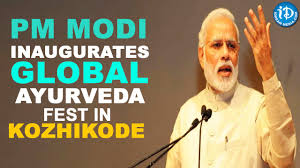
The Prime Minister, Shri Narendra Modi, today dedicated the All India Institute of Ayurveda, in New Delhi, to the nation.
Speaking on this occasion, the Prime Minister congratulated the gathering on the celebration of Dhanvantari Jayanti as Ayurveda Divas. He complimented the Ministry of AYUSH for the establishment of the All India Institute of Ayurveda.
The Prime Minister said that Ayurveda is not just a medical practice, but encompasses public health and environment health as well. That is why the Government has laid stress on integrating Ayurveda, Yoga and other AYUSH systems into the public healthcare system.
The Prime Minister said that the Government is working towards establishing an Ayurveda hospital in every district of the country. He said that more than 65 AYUSH hospitals have been developed in the last three years.
The Prime Minister said that herbal and medicinal plants can be a significant source of income, globally, and India should leverage its capabilities in this regard. He said the Union Government has approved 100 percent FDI in healthcare systems.
The Prime Minister said that the Government is focused on providing affordable healthcare for the poor. He said the stress has been on preventive health care and improving affordability and access to treatment. He said Swachhata – or cleanliness – is a simple mechanism of preventive healthcare. He said the Union Government has got 5 crore toilets built in three years.
The Prime Minister said that new AIIMS are being established to help the people get better access to healthcare. He mentioned measures such as capping prices of stents and knee implants; and the establishment of Jan Aushadhi Kendras for providing medicines at affordable prices.
Read more about the Ayurvedic movement worldwide.
Wednesday, October 4, 2017
The Indian government has pledged to broaden the roll-out of solar and battery storage to households without power in rural and remote towns and villages, as a part of a newly launched $2.5 billion project to electrify all of the country’s households by the end of 2018.
At the launch of the project on Monday, Indian PM Narendra Modi said around one-quarter of all homes in the country were yet to be electrified, meaning about 300 million of India’s 1.3 billion people are still not hooked up to the grid.
As part of the program, the government will identify households eligible for free electricity connections, with no fee charged for the connection of “poor citizens,” the PM said.
But the majority of the program’s budget – more than 80 per cent – would go towards rural households, where solar power packs of 200-300W will be added with battery banks to un-electrified homes, along with LED lights, a DC fan and a DC power plug, and repair and maintenance for five years.
As PV-Tech reports, Modi’s latest announcement appears to be a major extension of the plan announced last December by former energy minister Piyush Goyal, that more than 16,000 Indian households across 800 remote villages would be given a solar panel, with an eight-hour battery storage backup.
When the government first started rolling out its rural electrification program, known as DDUGJY, there were more than 18,000 villages identified as un-electrified.
The scale of the new plan, and its focus on solar and battery storage, also undermines one of the federal government’s key arguments in favour of digging up and exporting more Australia coal: that it is a vital source of “cheap electricity” for India’s poor.
“India has a massive program of expanding electrification across the country and Australian coal has a very big role to play in that,” Prime Minister Malcolm Turnbull said in April when he visited the sub-continent and met with Indian coal billionaire Gautam Adani, whose company is, still, deliberating its final investment decision on the $21-billion Carmichael coal mine in Queensland’s Galilee basin – Australia’s largest, if built.
But that’s not the view of many reports and energy industry analysts. In February, for instance, a report from The Energy and Resources Institute (Teri) in New Delhi, suggested that renewables and batteries could undercut coal in India in less than a decade, as long as costs of the technologies continued on their current trajectory.
And if that happens, the report adds, it will reduce the country’s carbon dioxide emissions by about 600m tonnes, or 10 per cent, after 2030.
One of the key goals of India’s solar and battery storage roll-out, which will be coordinated by the state-run Rural Electrification Corporation, is to cut use of kerosene in rural and remote areas, which is both a fire risk and a heavy pollutant.
The states are expected to complete the electrification by December 2018.
At the launch of the project on Monday, Indian PM Narendra Modi said around one-quarter of all homes in the country were yet to be electrified, meaning about 300 million of India’s 1.3 billion people are still not hooked up to the grid.
![]() |
| Prime Minister of India- Narendra Modi |
As part of the program, the government will identify households eligible for free electricity connections, with no fee charged for the connection of “poor citizens,” the PM said.
But the majority of the program’s budget – more than 80 per cent – would go towards rural households, where solar power packs of 200-300W will be added with battery banks to un-electrified homes, along with LED lights, a DC fan and a DC power plug, and repair and maintenance for five years.
As PV-Tech reports, Modi’s latest announcement appears to be a major extension of the plan announced last December by former energy minister Piyush Goyal, that more than 16,000 Indian households across 800 remote villages would be given a solar panel, with an eight-hour battery storage backup.
When the government first started rolling out its rural electrification program, known as DDUGJY, there were more than 18,000 villages identified as un-electrified.
The scale of the new plan, and its focus on solar and battery storage, also undermines one of the federal government’s key arguments in favour of digging up and exporting more Australia coal: that it is a vital source of “cheap electricity” for India’s poor.
“India has a massive program of expanding electrification across the country and Australian coal has a very big role to play in that,” Prime Minister Malcolm Turnbull said in April when he visited the sub-continent and met with Indian coal billionaire Gautam Adani, whose company is, still, deliberating its final investment decision on the $21-billion Carmichael coal mine in Queensland’s Galilee basin – Australia’s largest, if built.
But that’s not the view of many reports and energy industry analysts. In February, for instance, a report from The Energy and Resources Institute (Teri) in New Delhi, suggested that renewables and batteries could undercut coal in India in less than a decade, as long as costs of the technologies continued on their current trajectory.
And if that happens, the report adds, it will reduce the country’s carbon dioxide emissions by about 600m tonnes, or 10 per cent, after 2030.
One of the key goals of India’s solar and battery storage roll-out, which will be coordinated by the state-run Rural Electrification Corporation, is to cut use of kerosene in rural and remote areas, which is both a fire risk and a heavy pollutant.
The states are expected to complete the electrification by December 2018.
Subscribe to:
Posts (Atom)
I Love You, I'm Sorry, Please Forgive Me: Ho'oponopono
-
Tourism, a key sector in the world Over the past six decades, tourism has experienced continued expansion and diversification, and it has ...
-
Last week President of Caribbean South American Council visited Canada. He held discussions with many interested persons from the regional c...
-
Excerpt From NY Times By Natalie Hopkinson Dr. Natalie Hopkinson Natalie Hopkinson is the author of the forthcoming “A Mouth Is Alway...